Fibre-Reinforced Biomimetic Dentistry: Why Ribbond and EverX Are Quietly Changing How We Save Teeth
Some of the most important shifts in clinical dentistry happen quietly. They do not arrive as breakthroughs. They arrive as a slow accumulation of better outcomes, fewer emergencies, and teeth that should not have survived another decade somehow doing exactly that.
The shift towards biomimetic dentistry is one of those quiet revolutions. And at the centre of it, almost invisibly, are two materials: Ribbond, a polyethylene fibre mesh, and EverX, a short-fibre reinforced composite. Used together or apart, they have changed what a successful restoration looks like, what teeth we can save, and how often we reach for a crown when something less invasive will do the job better.
This guide is for anyone who wants to understand, in real depth, what these materials are, how they work, why they matter, and where they fit in modern restorative dentistry. It is written from the clinical perspective of a practice that uses them every day.
Part One: What Biomimetic Dentistry Actually Is
Biomimetic dentistry is sometimes described in vague, almost spiritual terms. “Mimicking nature.” “Working with the tooth.” Stripped of the marketing language, it is something far more concrete. It is a set of clinical principles, developed over the last three decades, that argues a simple thing: a restored tooth should behave as much like a healthy tooth as possible.
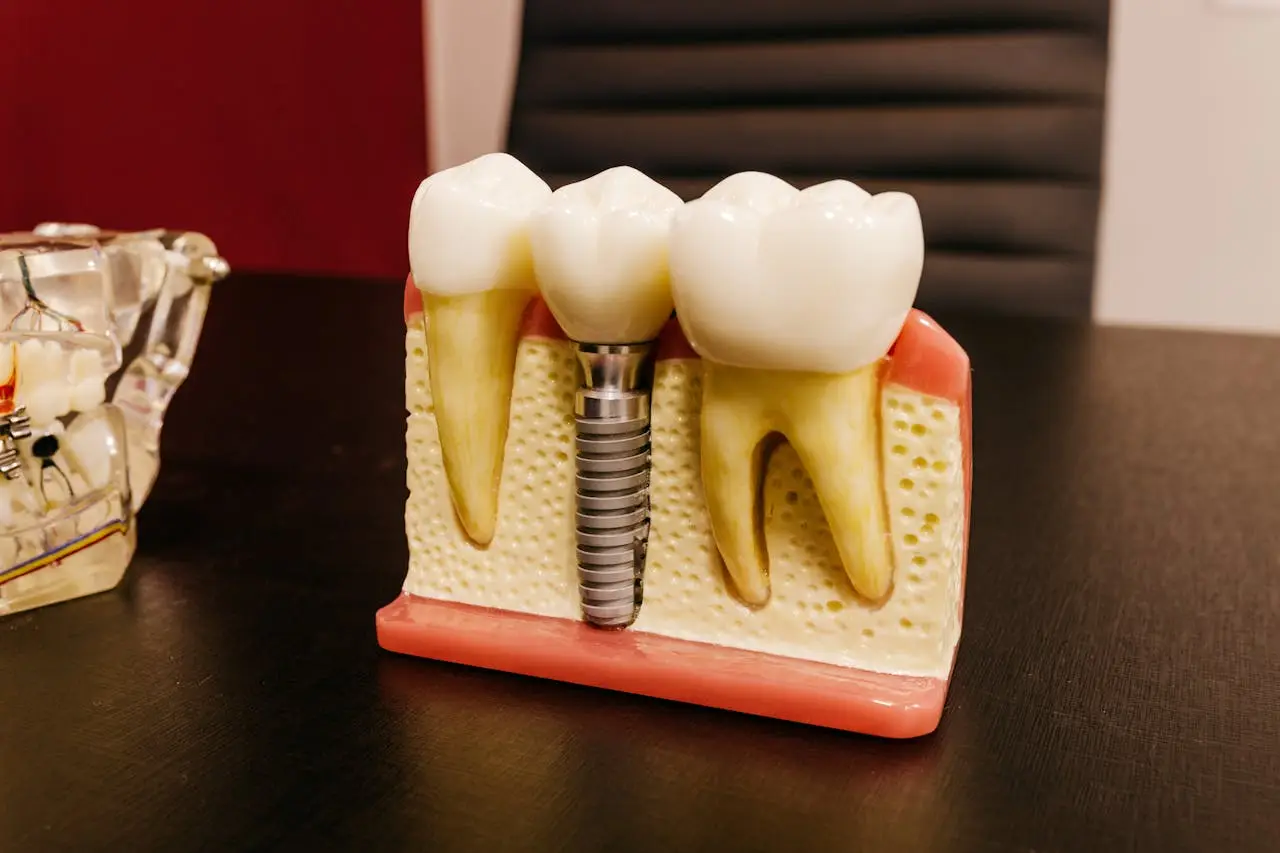
A healthy tooth is layered. Outside, enamel is hard, brittle, and beautifully resistant to wear. Inside, dentin is softer, slightly elastic, and laced with collagen fibres that make it tough rather than just strong. The junction between them, the dentino-enamel junction, is one of the most remarkable interfaces in the human body. It absorbs and redirects stress so that even when enamel cracks, the crack rarely propagates through dentin into the pulp.
For most of the twentieth century, restorative dentistry ignored this design. Amalgam fillings replaced lost tooth structure with a homogeneous metal block. Early composites replaced it with a homogeneous resin block. Crowns replaced the entire crown of the tooth with a homogeneous ceramic shell. None of these materials behaved like layered tooth structure. They were stronger or weaker, prettier or uglier, but they were not the same animal.
Biomimetic clinicians, beginning with the work of researchers like Pascal Magne and David Alleman, asked whether we could do better. Could we replace dentin with a dentin-like material and enamel with an enamel-like material? Could we preserve more healthy structure by using adhesion instead of mechanical retention? Could we reduce the stress at the bond line so restorations would stop failing at the margins? The answer, slowly proven over thousands of cases, was yes.
Three principles emerged. First, conservation. Remove only what is irreversibly damaged. Second, layering. Build the restoration in zones that mimic dentin and enamel. Third, stress reduction. Manage polymerisation shrinkage and occlusal forces so the bond between tooth and restoration is preserved over years, not months.
Fibres turned out to be central to making all three of these principles work in real clinical practice.
Part Two: Why Teeth Are Already Fibre-Reinforced
Open up dentin under a microscope and you find something that looks more like a textile than a stone. Roughly 30 percent of dentin by volume is type I collagen, organised in a precise, interwoven matrix. Embedded within and between these collagen fibres are crystals of carbonated apatite, the inorganic mineral that gives dentin its hardness.
This is not a coincidence. It is a design. The collagen fibres make dentin tough, meaning it resists crack propagation. The apatite crystals make it stiff, meaning it resists deformation. Together, they create a material that is both hard enough to support enamel and elastic enough to absorb the cyclic forces of chewing, which on a single molar can exceed seventy kilogrammes of load thousands of times a day.
When a microcrack forms in dentin under such loads, the collagen fibres do remarkable work. They blunt the crack tip. They bridge across the crack and hold its faces together. They divert the crack along irregular paths that consume energy and slow propagation. A homogeneous material would have already failed. Dentin, because of its fibres, survives.
Now consider what happens in a traditional composite restoration. There are no fibres. The material is homogeneous in every direction. A microcrack at the margin under cyclic chewing load travels in a straight line through the resin, picking up speed, until it either reaches the tooth-restoration interface and causes debonding, or reaches the surface and causes a chip. Either way, the restoration is on its way out, and the patient is on their way back to the chair.
This is why fibres matter. Not as a marketing feature, but as a missing structural element. Restoring a tooth without any fibre reinforcement is structurally similar to building a concrete column with no steel inside. It works for a while. It does not work for a lifetime.
Part Three: Ribbond in Detail
Ribbond is one of the most thoroughly studied dental fibres in the world, with literature going back to the 1990s. Yet many patients have never heard of it, partly because it sits inside the restoration where no one ever sees it.
The material itself
Ribbond is made of ultra-high molecular weight polyethylene, the same family of polymer used in bulletproof vests and surgical implants. The molecular chains are extraordinarily long, which gives the material remarkable tensile strength for its weight. The fibres are then woven in a leno pattern, a weave originally developed for industrial netting because of its resistance to unravelling. In Ribbond, the leno weave creates a fabric that does not fray when cut and that locks the fibres into a stable structure even under load.
There is one more piece of engineering that matters. Polyethylene in its raw form does not bond well to dental resins. Ribbond solves this with cold gas plasma treatment, which alters the surface chemistry of the polyethylene to make it strongly bondable to the methacrylate resins used in dentistry. Without this treatment, the fibre would sit inside the composite as an inert lump. With it, the fibre is structurally integrated with the surrounding resin.
The three variants and why thickness matters
This is the part that catches clinicians out, and it is worth getting right.
Ribbond Ultra (0.12 mm) is the thinnest variant and, in most space-critical clinical situations, it is the first-choice fibre. The reason is space economy. In a posterior restoration, every fraction of a millimetre of vertical space matters. The composite needs room to be layered properly, with adequate dentin replacement at the base, fibre reinforcement in the middle, and enamel-mimicking composite on top. A thicker fibre steals space from one of these zones, usually the enamel layer, and weakens the final result.
Ribbond THM (0.18 mm) is the second choice. It carries slightly more mass and offers stronger reinforcement, so it earns its place in larger periodontal splints, longer span trauma splints, and moderately deep posterior restorations where adequate space is available. THM is not a default. It is a deliberate choice when the case calls for more bulk.
Ribbond Original (0.35 mm) is the thickest variant and the least appropriate choice when space is limited. It is reserved for prosthetic frameworks and specific build-up cases where there is generous room and high reinforcement demand. Using Ribbond Original where Ribbond Ultra was indicated is a common error in clinical practice. The thicker fibre displaces composite volume the tooth needed, which paradoxically weakens the restoration the clinician was trying to strengthen.
The hierarchy is consistent in practice. Ultra first, THM second, Original last when space is the constraint.
Where Ribbond shines
Splinting is one of the clearest indications. After periodontal therapy or trauma, mobile teeth need to be stabilised without rigid metal wires that transfer stress unpredictably. A Ribbond splint, bonded into a shallow groove on the lingual surface and embedded in flowable composite, distributes load gently across multiple teeth. It is invisible to the patient and forgiving to the periodontium.
Post-and-core build-ups in endodontically treated teeth are another high-value indication. Cast metal posts have long been associated with vertical root fractures because their stiffness exceeds dentin’s. A Ribbond fibre post, bonded into the canal with a flowable composite, has a modulus far closer to dentin and distributes load more naturally. The result is fewer catastrophic root fractures and more teeth saved long term.
Reinforcement of large direct composite restorations is the third major use. In a heavily compromised tooth where a crown has been deferred, a Ribbond band placed across the pulpal floor or around the perimeter of the build-up reduces cuspal flexure and improves fatigue resistance.
Part Four: EverX Fiber in Detail
Where Ribbond is a fabric, EverX is a paste. Both contain fibres, but they deliver them to the restoration in fundamentally different ways.
The material itself
EverX, manufactured by GC, comes in two forms: EverX Posterior, a packable sculptable composite, and EverX Flow, a flowable version. Both contain millions of short E-glass fibres, each only a few millimetres long, dispersed randomly throughout a resin matrix. The matrix itself is a semi-interpenetrating polymer network, which allows the EverX layer to bond reliably to the conventional composite placed over it.
The randomness of fibre orientation is not a flaw. It is the entire point. A woven fabric like Ribbond reinforces along the direction of the weave. EverX, with its randomly oriented fibres, reinforces in every direction at once. When a microcrack starts in the restoration under chewing load and tries to travel through the EverX layer, it inevitably encounters fibres oriented across its path. These fibres blunt the crack, deflect it sideways, and force it to consume energy travelling through more material. The crack either stops or slows dramatically.
This crack-stopping behaviour has been demonstrated in laboratory fatigue studies and confirmed in long-term clinical use. EverX restorations show fewer catastrophic fractures over time than bulk composite restorations of the same size.
Where EverX shines
EverX is, above all, a dentin replacement material. Its modulus is closer to dentin than any conventional composite, which means it flexes with the tooth instead of fighting it. In a deep posterior cavity, EverX is placed as the bulk of the restoration, then capped with a thin layer of aesthetic composite that mimics enamel. The two-layer build replicates the natural tooth: a flexible, fibre-rich core under a hard, polished surface.
The deeper the cavity, the more EverX earns its place. In shallow restorations, conventional composite is fine. In large MOD cavities, in restorations where a cusp has been lost, in any case where the missing tooth structure is substantial, EverX brings durability that conventional composite alone cannot match.
EverX Flow, the flowable version, has additional uses. It can be placed as the very first layer over the cavity floor, where its flowability ensures complete adaptation to the underlying dentin. It can be used in narrow cavities where packable EverX is harder to manipulate. And it pairs naturally with Ribbond, flowing around the fibre to create a fully integrated reinforced layer.
Part Five: Ribbond vs EverX, and the Synergy Between Them
A common question, often asked by general dentists exploring biomimetic protocols for the first time, is whether Ribbond and EverX compete. They do not. They occupy different roles in the restoration, and in complex cases they appear together in the same tooth.
Ribbond is a directional fibre. Its strength runs along the orientation of the weave. This makes it ideal for any clinical situation where reinforcement is needed in a specific direction: across a splint, along the long axis of a post, or around the perimeter of a large composite build-up. Ribbond is a precision tool for targeted reinforcement.
EverX is an omnidirectional fibre composite. Its strength comes from random fibre orientation and full integration with the surrounding resin. This makes it ideal for bulk dentin replacement, where the restoration needs uniform crack resistance regardless of where the next stress concentration appears. EverX is a structural material for the body of the restoration.
In simple cases, one or the other suffices. A periodontal splint needs Ribbond, not EverX. A deep posterior restoration on a tooth with intact cusps needs EverX, not Ribbond. But in complex cases, both come into play. Consider a heavily broken-down molar with a previous root canal treatment. The clinical recipe might look something like this: a fibre post anchored with flowable composite into the canal, a layer of EverX as the dentin replacement filling the bulk of the cavity, a Ribbond band placed across the pulpal floor or around the build-up to add tensile reinforcement and reduce cuspal flexure, and finally an enamel-mimicking composite cap on top. Four layers, two fibre systems, one tooth that flexes and bonds and resists cracks the way a healthy tooth does.
This is biomimetics in its full clinical form.
Part Six: Technique Sensitivity Is Real
Fibre-reinforced biomimetic restorations are not difficult, but they are demanding. They reward precision and punish shortcuts. Three areas matter most.
Isolation. None of these materials work properly under salivary contamination. Rubber dam isolation is non-negotiable for biomimetic protocols. The bond strength to dentin and to the fibre system itself depends on keeping the field dry and clean throughout the procedure. Practices that have not adopted reliable isolation cannot deliver consistent biomimetic outcomes.
Bonding protocol. Ribbond and EverX both depend on the underlying tooth-resin bond holding up over time. Selective enamel etching, careful application of adhesive, immediate dentin sealing where appropriate, and full polymerisation of each layer are not optional refinements. They are the foundation on which the fibres do their work.
Layering discipline. A biomimetic restoration is only as good as the layers it is built from. Skipping the dentin replacement layer to save time, applying composite in chunks too thick to cure properly, neglecting to plasticise the resin around the Ribbond fibre, all of these compromise the final outcome. The technique works when the protocol is followed completely. It fails in proportion to the corners that are cut.
This is why biomimetic dentistry is not, and probably never will be, a high-volume procedure. It rewards clinicians who slow down, isolate properly, layer carefully, and treat each tooth as a structural problem with a structural solution.
Part Seven: The Evidence Base
For clinicians and patients who want to know what the literature says, the evidence on Ribbond and EverX is robust and growing.
Ribbond has been studied in laboratory and clinical settings since the late 1990s. Studies have demonstrated its ability to increase the fracture resistance of large composite restorations, reduce cuspal flexure under load, improve the survival of post-and-core build-ups in endodontically treated teeth, and stabilise mobile teeth in periodontal splints with high patient satisfaction at multi-year follow-up.
EverX, while a more recent material, has been the subject of an accelerating body of research. Fatigue studies show significantly lower crack propagation rates compared with conventional composites. Clinical follow-up studies have reported strong performance in large posterior restorations over five-year periods. The material is well recognised in international restorative dentistry guidelines as a dentin-replacement option in deep posterior cavities.
Neither material is experimental. Both are mainstream in the clinics and academic departments where biomimetic dentistry is practised at a high level.
Part Eight: When Not to Use Fibres
Honest dentistry includes knowing the limits of any technique. Fibre-reinforced biomimetic restorations are not the right answer in every case.
If a tooth is so heavily compromised that no enamel and very little dentin remain, the case may demand a crown, regardless of philosophy. Adhesion needs healthy structure to adhere to. When that is gone, full coverage is the safer choice.
If a patient has severe bruxism that has already destroyed previous restorations, the occlusal forces may simply exceed what a direct restoration can absorb, fibre reinforcement included. Splint therapy, occlusal management, and indirect restorations may be more appropriate.
If a tooth has cracks that have already propagated below the gingival margin or into the pulp chamber floor, no fibre can rebuild what is already broken. The realistic options narrow to crown lengthening, root canal treatment with a crown, or extraction.
A clinician who recommends fibre-reinforced restoration in every case is selling, not diagnosing. The technique is powerful precisely because it is selective.
Part Nine: What Patients Can Expect
For patients, the practical experience of a biomimetic restoration is closer to a long, careful filling than to a crown procedure. There is no temporary, no second visit for cementation, no removal of healthy enamel to make space for a ceramic shell. The procedure is typically completed in one extended visit under local anaesthesia and rubber dam isolation.
In return, patients can expect a restoration that feels like part of the tooth, that does not require the periodic replacement common with crowns over decades, and that preserves the option of more aggressive treatment later if it ever becomes necessary. A biomimetic restoration is reversible in a way a crown never is. If a crown is later required, it will be required on a tooth that has had less structure removed, not more.
The most common surprise for patients is how unspectacular the recovery is. There is no visible reminder that something dramatic was done. The tooth simply works.
Part Ten: Common Myths
A few persistent myths are worth addressing directly.
Myth: fibre-reinforced restorations are weaker than crowns. In well-selected cases, the opposite is closer to the truth. Crowns remove healthy tooth structure to provide retention. Biomimetic restorations preserve healthy structure. The remaining tooth is stronger, not weaker, when more of it is intact.
Myth: these materials are only for front teeth. EverX in particular was developed specifically for posterior use, where occlusal forces are highest. Ribbond is used routinely in molars for splinting, post-and-core, and reinforcement.
Myth: this is experimental dentistry. Ribbond has been in clinical use for over twenty-five years. EverX has been on the market for over a decade. Both are supported by peer-reviewed literature and used in academic dental departments worldwide.
Myth: it is just a cosmetic alternative to crowns. Biomimetic dentistry is structural before it is cosmetic. The aesthetic outcomes follow from sound structural principles, not the other way round.
Part Eleven: At Redefine Dental Clinic
At Redefine Dental Clinic in Kalyan West, Mumbai, biomimetic protocols are part of routine practice. Dr. Gautam Shetty, a micro-endodontist with over 15 years of clinical experience, integrates Ribbond and EverX into restorative cases where they offer a measurable advantage over traditional approaches.
Treatment planning begins with diagnosis. Every case is evaluated for whether biomimetic restoration is appropriate, whether a more conservative approach can save the tooth without a crown, and whether fibre reinforcement will measurably improve the long-term prognosis. Where it does, the protocol is followed completely: rubber dam isolation, careful adhesive bonding, layered restoration with EverX as dentin replacement and Ribbond where indicated, and final occlusal adjustment to ensure the restoration loads as intended.
The clinic’s approach is conservative, evidence-based, and oriented towards long-term tooth survival rather than short-term convenience. Patients in Kalyan, Dombivli, Thane, and across the Mumbai region regularly travel for second opinions on cases where they have been quoted crowns or extractions, and a meaningful proportion of those teeth go on to be saved with biomimetic protocols.
Frequently Asked Questions
What is biomimetic dentistry? Biomimetic dentistry is an approach to restoring teeth that copies the natural structure and behaviour of dentin and enamel. Restorations are built in layers, using materials chosen to flex, bond, and absorb stress the way a healthy tooth does, with the goal of preserving as much natural tooth structure as possible.
Is Ribbond stronger than EverX Fiber? They are not directly comparable. Ribbond provides directional tensile strength and is used for splinting and targeted reinforcement. EverX provides omnidirectional crack resistance and is used as a dentin replacement layer. In complex cases, both are used together.
Which Ribbond should be used in a deep posterior restoration? In most space-critical clinical situations, Ribbond Ultra at 0.12 mm is the appropriate choice, because it adds reinforcement without consuming the limited vertical space available for proper composite layering. Ribbond THM at 0.18 mm is the next option when more space allows. Ribbond Original at 0.35 mm is reserved for cases with adequate room and high reinforcement demand.
Can biomimetic restoration replace a crown? In many cases, yes. A well-planned biomimetic restoration with Ribbond and EverX can preserve enough tooth structure to avoid a crown, particularly in cases where a crown would have been recommended out of habit rather than absolute necessity. Whether a crown is still indicated depends on the remaining tooth structure, occlusal load, and the presence of cracks. The decision is made case by case.
Are Ribbond and EverX safe long-term? Both materials have been in clinical use for years with strong evidence bases. Ribbond UHMWPE fibres are biocompatible and chemically inert. EverX E-glass fibres are encapsulated within a stable resin matrix. Both are well documented in peer-reviewed dental literature.
Does the procedure take longer than a regular filling? Yes. A biomimetic restoration takes longer than a conventional filling because of the careful isolation, adhesive protocol, and layering required. Most cases are completed in a single extended visit, but the visit itself is longer than a standard composite filling.
Is biomimetic dentistry more expensive than a crown? The cost of a biomimetic restoration is typically lower than the cost of a crown in the short term, because there is no laboratory work involved. Over a lifetime, the cost difference depends on whether the biomimetic restoration succeeds in preserving the tooth without subsequent crown work. In most successful cases, the lifetime cost is significantly lower.
Can these techniques be used on root canal treated teeth? Yes. In fact, endodontically treated teeth are among the most rewarding cases for biomimetic protocols. A fibre post combined with EverX dentin replacement and Ribbond reinforcement can rebuild a root canal treated tooth without the need for a crown in many cases, preserving healthy tooth structure that a crown preparation would have removed.
Is biomimetic restoration suitable for children and young patients? It is particularly suitable for young patients, because preserving natural tooth structure early in life means avoiding decades of crown replacement cycles later. Young patients with large restorations are some of the clearest beneficiaries of the biomimetic approach.
Where can patients in Mumbai access biomimetic restoration? Redefine Dental Clinic in Kalyan West, Mumbai, offers biomimetic restorative protocols including Ribbond reinforcement and EverX-based core build-ups. Consultations include a discussion of whether the approach is appropriate for the patient’s specific clinical situation.
Closing Thought
The future of restorative dentistry will not be built on stronger ceramics or harder composites alone. It will be built on the realisation that a tooth is not a solid block but a layered, fibre-reinforced biological structure, and that the best restorations are the ones that respect that design.
Ribbond and EverX are two of the clearest expressions of that idea in modern clinical practice. They are not miracle materials, and they are not right for every case. But used well, by clinicians who understand the architecture they are replacing, they do something quietly extraordinary. They give patients back something close to the tooth they were born with.
For patients in Mumbai considering treatment options for a heavily restored, fractured, or root canal treated tooth, the question worth asking is not “what crown should I get?” It is “is there a way to rebuild this tooth without a crown?” In a growing number of cases, the answer is yes.
To book a consultation with Dr. Gautam Shetty at Redefine Dental Clinic, Kalyan West, Mumbai, please visit the clinic page or call the front desk.